November 24, 2026
Corporate Event Photography: Candid Coverage That Works
How to plan corporate event photography: what to shoot, how to brief a photographer, typical US rates, deliverables and usage rights, plus candid coverage in Columbus.
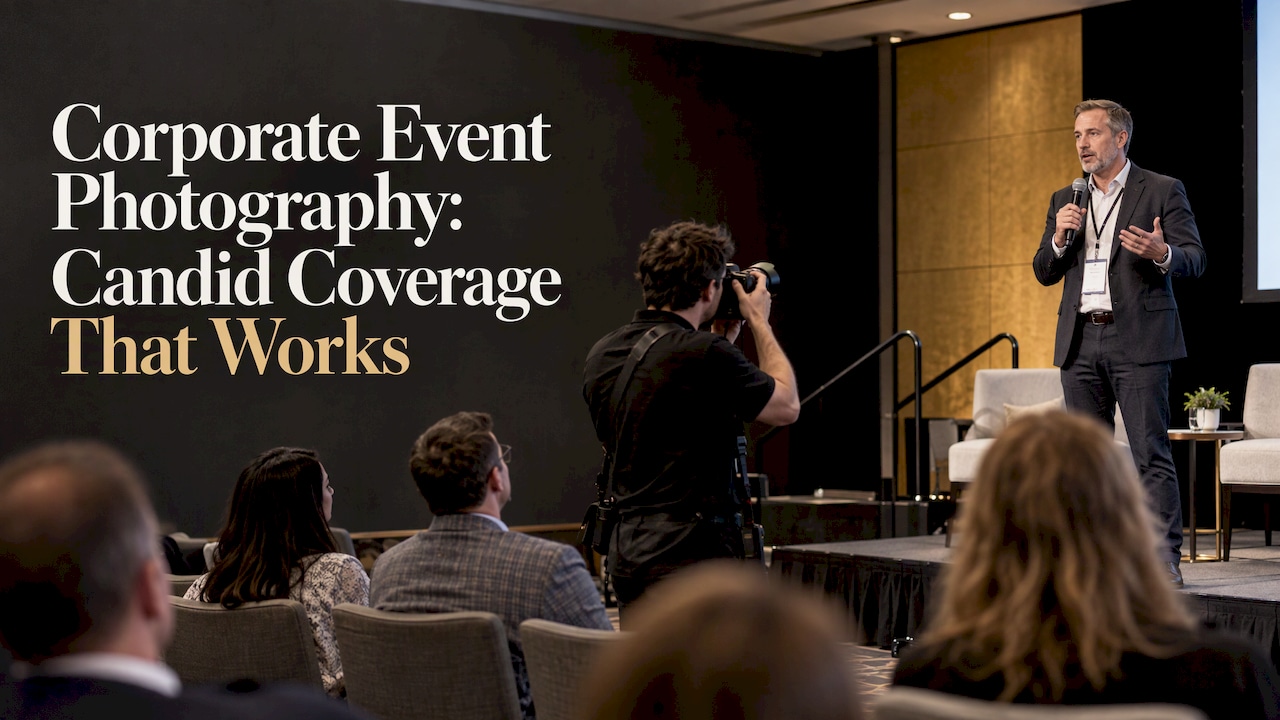
Corporate Event Photography: Candid Coverage That Works
Good corporate event photography gives you images of what actually happened: the keynote, the handshake, the laugh at the networking table. That is why we cover company events with minimal direction and no staged setups. At Maxx Slater Photography in Columbus, Ohio, live event coverage is built on candid, unposed moments, so the gallery you receive looks like your event felt, not like a lineup of forced smiles.
Below is what corporate event photography includes, what to shoot, how to brief a photographer, what it typically costs in the United States, and what to settle about deliverables and usage rights before the day.
TL;DR
- Corporate event photography documents a conference, gala, launch, retreat or awards night so you can use the images for marketing, internal communications and press afterward.
- Candid coverage, with minimal direction, produces more natural images of people than lining guests up for posed shots.
- US public price lists put event photography at roughly $150 to $375 per hour with a two-hour minimum, with half and full days priced separately.
- Give your photographer a timeline, a venue layout, access points and a list of key people before the day.
- Settle delivery timing and image usage rights in writing before the event. Commercial usage is negotiated separately with us.
Table of Contents
- What corporate event photography actually covers
- Why candid beats posed at a company event
- What the photographer should capture
- How to brief your photographer
- What corporate event photography costs in the US
- Deliverables, editing and turnaround
- Image usage rights, explained
- Photographing a corporate event in Columbus
- Why companies in Columbus book us for events
- A simple planning timeline
- FAQ
- Sources
What corporate event photography actually covers
Corporate event photography is the documentation of a business gathering: conferences, product launches, trade show booths, company parties, galas, award ceremonies, team retreats and client dinners. The photographer works while the event runs, which means there are no retakes. The moment happens once.
That is what separates it from a headshot day or a branded studio session. In a studio, the photographer controls the light, the pose and the timing. At an event, the photographer reads the room, anticipates where the next good moment will occur and stays out of the way.
Most companies hire for three reasons:
- Marketing content. Website, social posts, recap emails and next year’s sponsor deck.
- Internal culture. Photos that show employees at an offsite or celebration, used in newsletters and recruiting.
- Proof for stakeholders. Sponsors, clients and executives want to see attendance, engagement and brand visibility.
Each reason favors the same kind of image: real people, mid-action, looking like themselves.
Why candid beats posed at a company event
A true candid photograph is defined by the absence of posing: the subject isn’t arranging their face or body for the camera. Photography educators also distinguish true candids from “directed candid” images, which are staged to look unposed. Both have a place, but at a live event the first kind carries the energy the second kind imitates.
There is a practical reason too. Event attendees are working: networking, listening, eating, presenting. Stopping them every few minutes for a group pose disrupts the event and produces the stiff expression everyone recognizes from the standard conference photo wall.
Our approach is to photograph with minimal direction, without forced smiles or posed setups, so genuine emotion shows. For an organizer, that means:
- Your guests are not interrupted, so the event keeps its pace.
- Speakers are caught in motion rather than frozen at a podium.
- Networking images show real conversations, which read as credible on a company website.
- The gallery has range: wide room shots, small-group moments and close expressions.
If you need a few formal frames, such as a leadership group or a sponsor lineup, say so in the brief and they can be folded into the day alongside the candid coverage.
What the photographer should capture
A shot list keeps the day focused. One published event shot list ranks priorities in tiers: the must-have frames first (venue exterior with signage before doors open, registration and check-in, the logo wall, a wide shot of the keynote in the first minutes, the speaker mid-action, audience reactions, booth interactions at peak traffic, small-group networking, award winners on stage) and the nice-to-haves after (staff group photos, behind-the-scenes, badges, food and décor).
Translated into a working list for a typical one-day conference or company event:
Before guests arrive
- Venue exterior and entrance signage
- Stage, screens and room setup from a wide angle
- Branded items: banners, step-and-repeat walls, table settings, signage
- Registration desk before the line forms
During the program
- A wide establishing shot of the keynote early, while the room is full
- Speakers in motion: gesturing, laughing, taking questions
- Audience reactions, which tell the story of how the content landed
- Panel moments and Q&A
- Awards and presentations, including the handoff and the applause
During breaks and networking
- Conversations of two to four people, the most usable images for marketing
- Sponsor and exhibitor booths when traffic is highest
- Details: coffee lines, hallway conversations, laughter
At the close
- Closing remarks, a wide shot of the room, departures
- Any team photos you requested, done quickly
The order matters because room conditions change. Empty-room shots are only available early. Peak-traffic shots happen once and cannot be repeated.
How to brief your photographer
The best event galleries come from a clear brief, not from more hours. Eventbrite’s event photography guide recommends giving the photographer a timeline for the day and a venue layout, listing access points including restricted areas, scheduling a venue scout two or three days ahead, and naming the key people to photograph along with anyone who should not be photographed.
Turn that into a one-page brief:
- Timeline. Doors, sessions, breaks, meals, awards, close. Mark the three moments that matter most.
- Venue map. Where the stage, registration, sponsor area and green room are.
- Access. Loading dock, back-of-house doors, restricted rooms, parking and badge pickup.
- People. Executives, speakers, award recipients and sponsors to prioritize. Add anyone who should not be photographed.
- Brand needs. Logos, signage, products or sponsors that must appear in the frame.
- Use. Where the images will run: website, press, social, internal, sponsor reports. This drives both your shot list and your usage rights.
- Point of contact. One person at the event who can answer questions by text.
Two extra steps help at larger venues. First, ask the photographer to arrive before doors open for the empty-room shots. Second, tell your speakers and staff that a photographer will be moving through the room, so nobody is surprised and nobody feels they must stop and pose.
Consent and privacy
If your guests include clients, minors or people with privacy concerns, say so early. Many organizers add a short notice on the invitation or at registration that photography will take place. Check with your own legal or HR contact on the wording that suits your company and state.
What corporate event photography costs in the US
Prices vary by market, event length and what you plan to do with the images. As a reference point, a 2026 guide compiled from seven US photographers’ public price lists reports:
| Coverage | Published range |
|---|---|
| Hourly | $150 to $375 per hour, with a two-hour minimum |
| Half day (4 hours) | $500 to $2,000 |
| Full day (8 hours) | $900 to $3,500 |
The same guide lists common add-ons: a second photographer at about $120 per hour, rush delivery at about $300 per day, and attendee gallery hosting at about $500. These are the published figures for those seven price lists, not a quote for your event.
What moves the price for your event:
- Hours of coverage. A two-hour reception costs less than an all-day conference.
- Second photographer. Useful when two rooms run at once or the venue is large.
- Turnaround. Faster delivery usually costs more.
- Usage rights. Images used in paid advertising or by sponsors can be priced differently from internal and website use.
- Market. City and venue type both shape rates.
We do not publish a price list. Each event is scoped and quoted around the hours, the brief and the usage you need, so you pay for the coverage your event requires.
Deliverables, editing and turnaround
Ask three questions before you book.
How many images, and in what form? Corporate galleries are normally delivered as edited, high-resolution digital files, often with web-sized versions for social posting. Agree whether you receive a curated selection or every usable frame.
When will you receive them? Common contract language splits delivery into two stages: a quick highlight set within 24 to 72 hours for corporate events, and the full gallery in one to two weeks. If you plan to post recap content the next morning, tell the photographer up front so the schedule is built for it.
What does editing include? Color correction, exposure and cropping are standard. Heavy retouching is a separate conversation. Our work leans toward natural, unfiltered results, which keeps the images true to the event and the people in them.
Put the answers in the booking agreement alongside the coverage hours, the location list, the overtime terms and the cancellation terms.
Image usage rights, explained
Usage rights are the part of the contract most companies skip and later regret.
In the United States, the person who takes a photograph generally owns its copyright unless there is a written assignment or a valid work-made-for-hire arrangement. Paying for a shoot does not by itself transfer copyright. What you receive is a license to use the images, and the license should say how.
Spell out:
- Where the images can run: your website, social channels, print, press releases, investor decks, paid ads.
- Who can use them: your company only, or also sponsors, speakers and partners.
- How long the license lasts.
- Whether the photographer may use the images in a portfolio.
Our commercial image usage rights are negotiated separately from the session fee. That means you tell us how the images will be used and the license is written to fit, rather than paying for rights you will never exercise.
Photographing a corporate event in Columbus
Columbus hosts a steady calendar of conferences, association meetings, product launches and company celebrations, from downtown hotel ballrooms and the convention center to breweries, galleries and warehouse spaces in neighborhoods such as the Short North and Franklinton. Each type of venue asks for a different approach.
- Ballrooms and convention halls call for wide, clean room shots and a photographer who can move quietly between sessions.
- Industrial and gallery spaces often have mixed lighting and dramatic settings. The result can be striking when the photographer works with the available light rather than against it.
- Outdoor and multi-site events such as company field days or customer ride-and-drives need a photographer who can follow the schedule across locations.
Because we are based in Columbus, scouting a venue before the day is straightforward, and you are not paying to bring in a photographer from out of town.
Why companies in Columbus book us for events
Most corporate event galleries look alike: lined-up handshakes, a banner behind the speaker, a group squint toward the lens. Those images document attendance, but they rarely make anyone want to attend next year.
We photograph with minimal direction, so what you receive shows the event as people lived it. That matters when your photos need to do real work: recruiting prospective employees, attracting sponsors, or giving clients a reason to say yes to next year’s invitation.
Our work spans live events, documentary photography, editorial and brand imagery, and automotive photography. That mix helps when your event has more than one job. A product launch can need candid crowd coverage, a few brand images of the product, and editorial-style portraits of your speakers. A dealership or vehicle brand event can pair guest candids with detailed vehicle photography. You can see the range in the portfolio.
If your event is part of a larger brand push, our brand photography and fashion and editorial photography pages show how the same candid approach carries into planned shoots.
Planning a conference, launch, gala or company celebration in Columbus? Our live event photography is booked directly: tell us the date, the venue, the schedule and where the images will be used, and we will scope the coverage around it.
A simple planning timeline
Use this sequence for any corporate event, adjusting the lead time to the size of the event.
- Weeks before. Choose your photographer, confirm the date, and agree on coverage hours, deliverables and usage rights in writing.
- Two to three weeks before. Send the timeline, venue layout, access list and priority people.
- Two to three days before. Walk the venue with the photographer, or send current photos of the room if a visit is not possible.
- Day of. Share the point of contact. Brief the host or emcee that a photographer will be moving through the room.
- Within a few days. Receive the highlight set and post the recap while the event is fresh.
- Within a couple of weeks. Receive the full gallery, then file images with the license terms attached so anyone on your team knows how they can be used.
FAQ
What is corporate event photography?
It is professional photography of a business event: conferences, galas, product launches, award nights, retreats and similar gatherings. The photographer documents speakers, guests, branding and atmosphere so the company can use the images for marketing, internal communications and records afterward.
How much should a photographer charge for a corporate event?
Published US price lists put hourly coverage at about $150 to $375 with a two-hour minimum, half days from $500 to $2,000 and full days from $900 to $3,500, according to a 2026 compilation of seven photographers’ rates. Your quote depends on hours, a second photographer, turnaround and usage rights. We scope each event individually.
How many hours of coverage do I need?
Cover the moments that matter most to you, not the whole clock. For a conference, that usually means the early arrival and setup shots, the opening keynote, the key sessions, networking breaks and the close. A short reception can be covered in two to three hours, while a full conference day calls for half or full-day coverage.
Who owns the photos from a company event?
In the US, the photographer generally holds the copyright unless a written agreement says otherwise, and the company receives a license to use the images. Put the license terms in your agreement: where the images can run, who can use them and for how long. With us, commercial usage rights are negotiated separately so they match your plans.
Can candid coverage still include a few group photos?
Yes. Candid coverage is the foundation, and a short list of formal frames, such as a leadership team or award recipients, can be added to the schedule. Tell your photographer which groups you need and when they will be together.